Roof Lantern & Skylight Blinds
Control the light
above you.
Made-to-measure blinds for roof lanterns, orangeries, skylights and extensions. Motorised as standard — survey, supply and fit by our own team across Lancashire.
Why Lantern Blinds Matter
Your lantern is beautiful.
Until it isn't.
A roof lantern transforms a room — flooding it with natural light and creating a stunning architectural focal point. But without the right blind, that same feature becomes a problem. Intense summer heat makes the room unusable. Glare makes screens impossible to see. Winter cold pours through the glass. And at night, you're on full display to anyone who looks up.
A well-specified lantern blind solves all of this — managing heat, glare and privacy while preserving the beauty of the feature itself. Done right, the blind is almost invisible when open and effortlessly functional when closed. We're a small Lancashire team who have been specifying and fitting lantern blinds since 2007. We'll visit your home, assess your lantern properly, and give you an honest recommendation — not just the most expensive option.

The Problem With Unshaded Lanterns
Four reasons every lantern
needs a blind.
Roof lanterns and skylights are one of the few window types where the consequences of not having a blind are felt every single day — in every season.
South-facing lanterns can raise a room's temperature by 10°C or more on a sunny day. Without shading, an extension or kitchen diner becomes genuinely uncomfortable — often unusable — for weeks at a time in summer. A good lantern blind can reduce solar gain dramatically, keeping the room cool without sacrificing the light entirely.
Glass is a poor insulator — and a large expanse of roof glazing will lose heat rapidly in cold weather. A honeycomb cellular blind closed over the lantern at night acts as an effective thermal layer, trapping air and significantly reducing heat loss. This is particularly noticeable in rooms with underfloor heating or limited radiators.
Overhead glazing produces a particularly harsh, direct glare that's almost impossible to avoid — unlike a side window where you can simply turn away. Screens become unreadable, reading becomes uncomfortable and the room feels relentlessly bright on sunny days. A light-filtering blind takes the edge off the glare while keeping the room feeling open and airy.
At night, with lights on inside, a roof lantern is essentially a skylight into your home for anyone in an elevated position — a neighbour's upstairs window, a garden wall, or simply anyone looking up. A blind closed at night resolves this completely and gives the room a finished, dressed feeling regardless of the season.


Blind Options
Choose the right blind
for your lantern.
Not all lantern blinds are the same — fabric type makes a significant difference to both performance and appearance. We'll advise on the best option for your specific lantern, orientation and how the room is used.
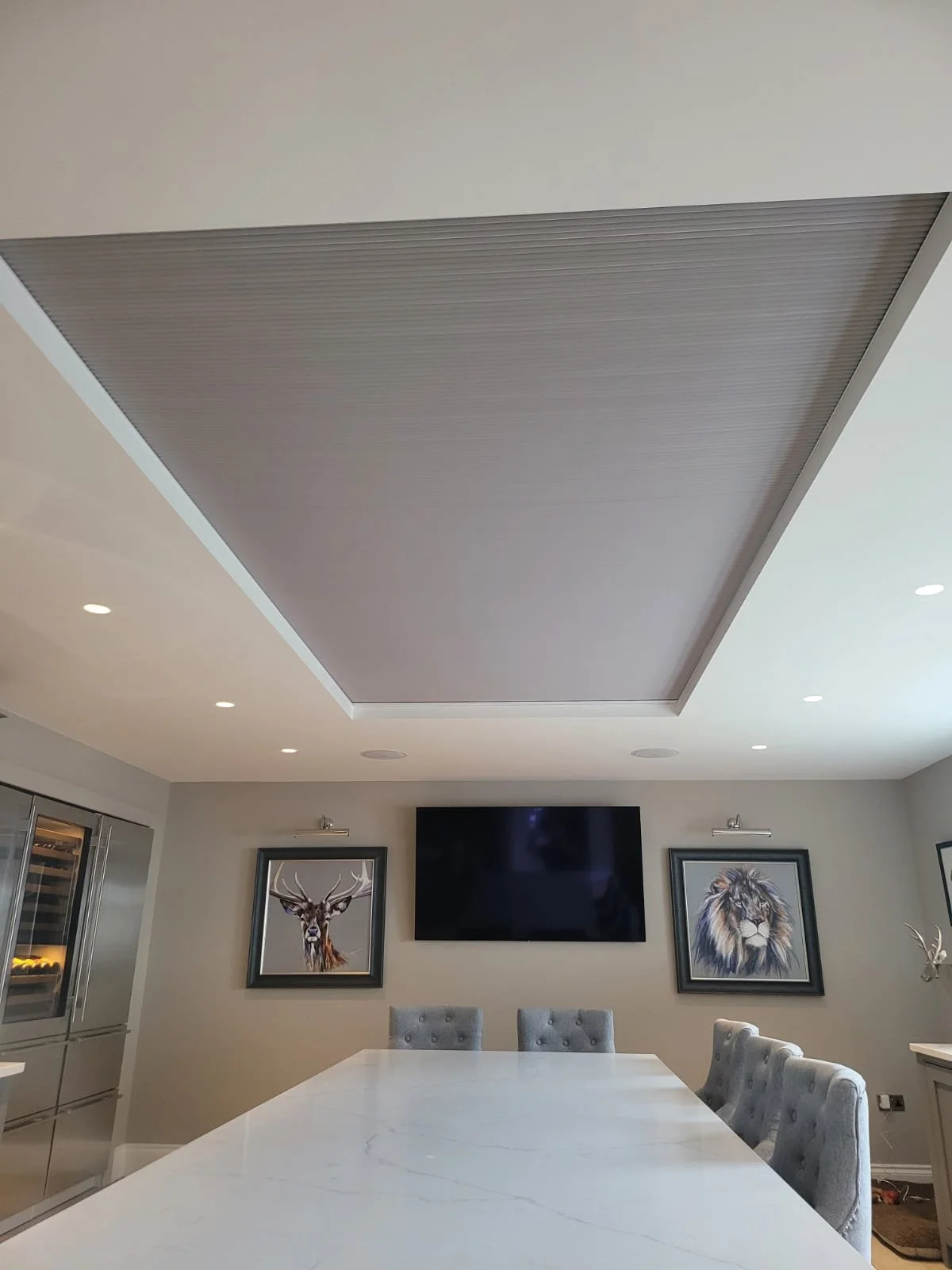
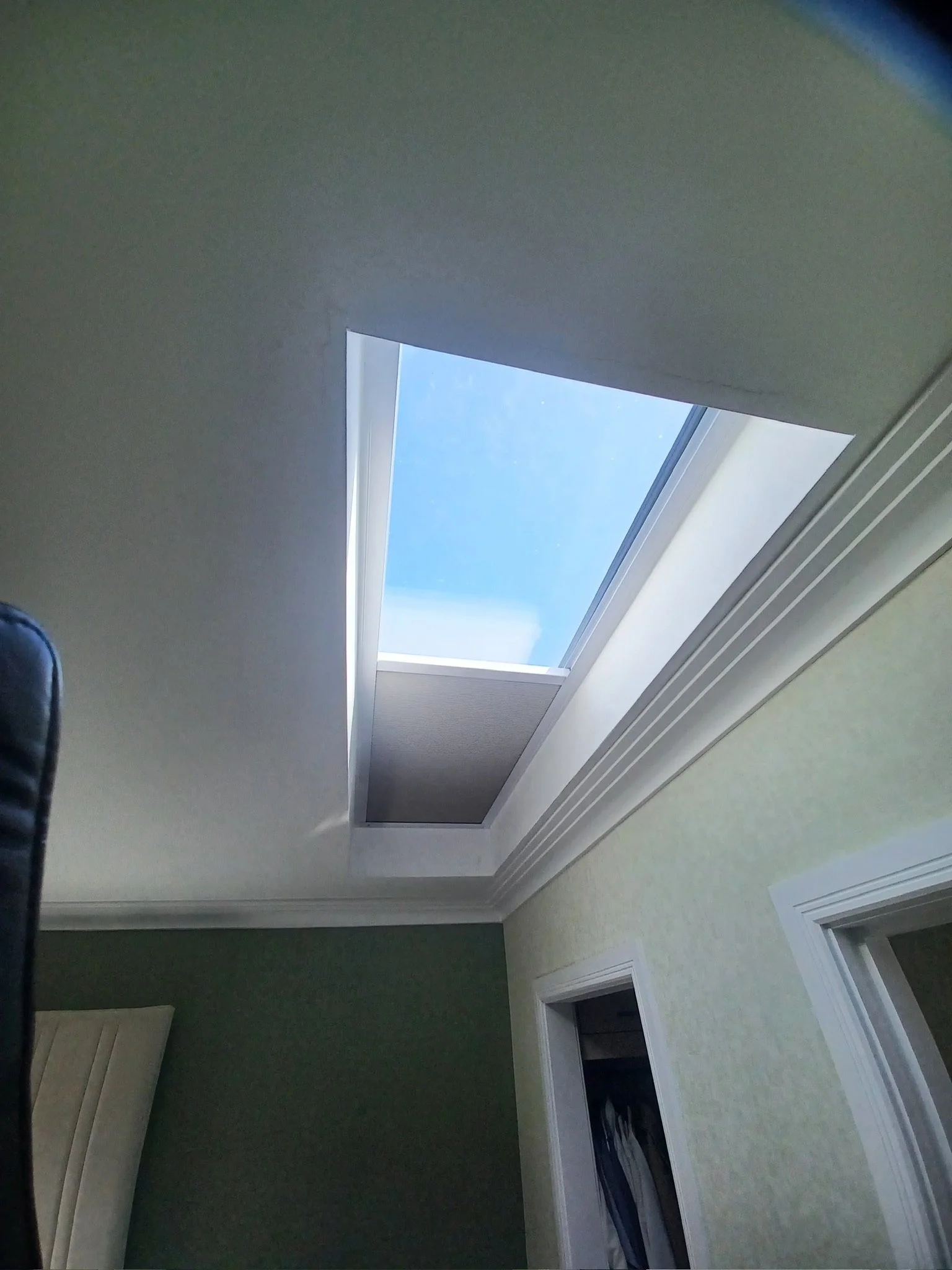
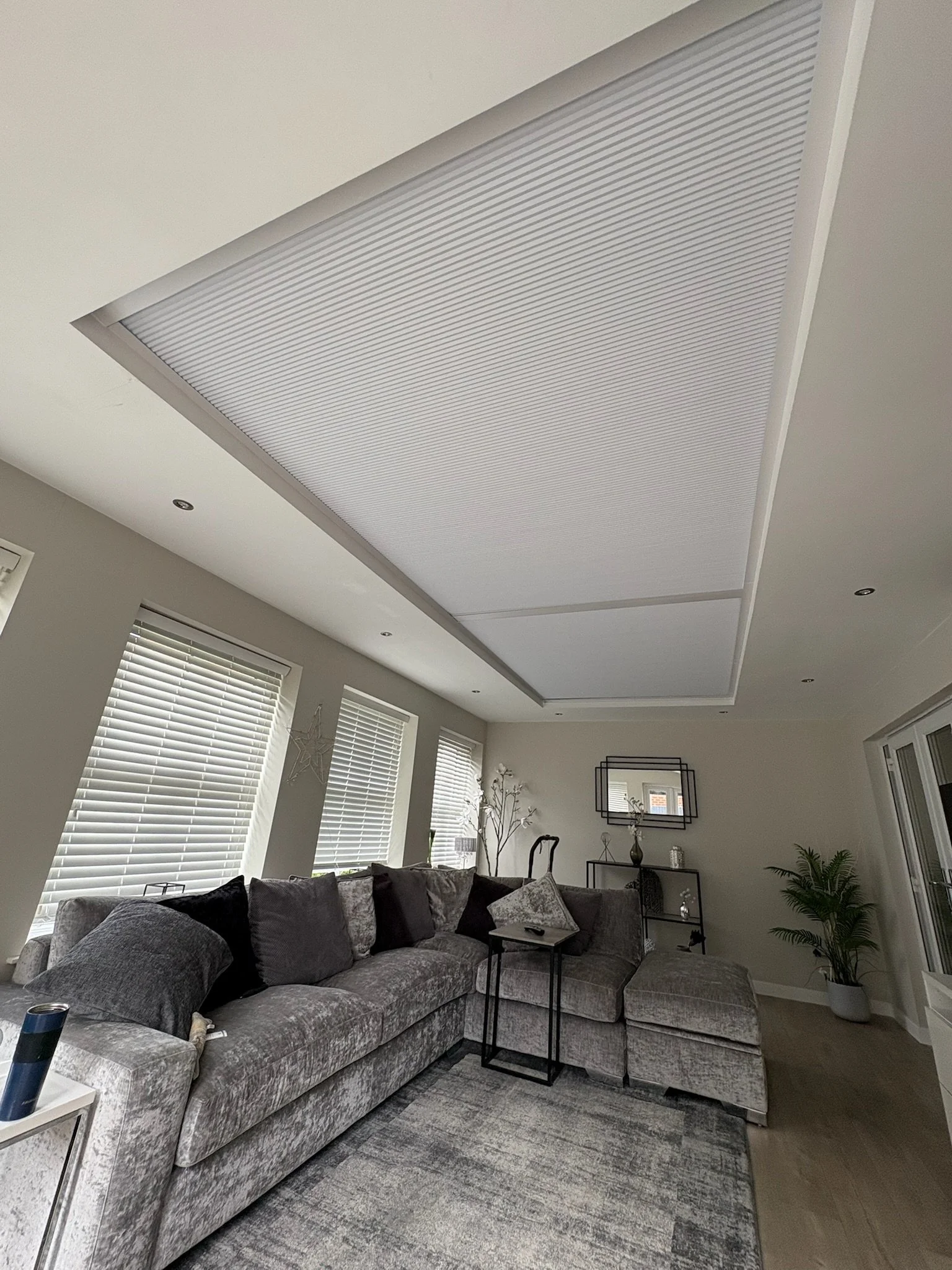
The most popular choice for lantern blinds and the one we most commonly recommend. Honeycomb cellular fabric traps air in its double-walled structure, creating a highly effective thermal barrier — reducing heat gain in summer and heat loss in winter. The fabric diffuses light beautifully, softening harsh sunlight without blocking it entirely when partially closed.
Pleated blinds offer a crisp, tailored look with a compact stack when raised — making them a clean, unobtrusive choice for lanterns where aesthetics are particularly important. Available in a wide range of fabrics from sheer light-filtering to full blackout, with a variety of textures and colours. They're slightly thinner in profile than honeycomb when stacked, which can be an advantage on smaller lantern frames.
Roller blinds for lanterns use the same tension and belt-track system as pleated and honeycomb options — keeping the fabric taut and straight across the opening with no sagging. The flat roller fabric gives a particularly clean, contemporary appearance and works especially well on large, modern lantern roofs over open-plan spaces. Available in a wide range of performance fabrics from screen weaves to total blackout.
Power Options
Solar, battery
or mains — which suits you?
Lantern blinds are almost always motorised — operating them manually from below is impractical and, for larger lanterns, simply impossible. The question is how they're powered. Here's an honest breakdown of each option.
Rechargeable battery motors are the most common choice — and for good reason. They require no electrical connection, which means no disruption to existing ceilings or decoration. The motor sits within the blind cassette and is recharged via a USB-C cable every few months depending on usage. Simple, clean and completely retrofit-friendly.
A single battery charge typically lasts around six months with regular daily use — so most customers recharge twice a year. When charge is running low, the blind gives a gentle visual reminder. Recharging takes a few hours via USB-C and can be done without removing the blind.
Best for: Retrofits, existing builds, no rewiring requiredA small solar panel — typically clipped to the lantern frame or mounted nearby — continuously charges the battery as daylight enters the room. In a well-lit space, a solar-powered lantern blind can be essentially self-sustaining, rarely if ever needing a manual recharge. An excellent solution for south-facing lanterns that receive direct sunlight throughout the day.
Solar panels are discreet and can usually be positioned so they're not visible from inside the room. We assess your lantern's orientation at the survey to confirm whether solar is viable for your specific installation.
Best for: South-facing lanterns, sustainable homes, minimal maintenanceFor larger lanterns, very frequent use, or installations where running costs and maintenance are a priority, a hardwired mains motor is the most robust solution. It requires an electrical connection to be run to the lantern head — ideally planned during construction or a significant renovation when ceilings are open. Mains motors are more powerful, handle larger blind sizes and have no charging requirement whatsoever.
We work alongside your electrician to coordinate the cable run — or can recommend trusted local electricians if needed. All mains installations are compatible with Somfy smart home systems.
Best for: New builds, large lanterns, frequent daily useSmart Control
Motorised as
standard.
Unlike most blinds, lantern blinds are almost always motorised — the height makes manual operation impractical and, for larger installations, impossible. As a Somfy Expert Partner, we specify and install motor systems that integrate seamlessly with your smart home, giving you total control over light, heat and privacy from anywhere in the room.
Control via a slim Somfy remote, the TaHoma app, or voice command through Amazon Alexa, Google Home and Apple HomeKit. Set schedules so blinds close automatically at peak sun hours — or open to greet the morning.
Sizing & Configurations
Every lantern size
accommodated.
Lanterns come in all shapes and sizes — from a compact kitchen extension skylight to a large orangery roof spanning several metres. We specify the right system and configuration for your exact dimensions, with no compromise on performance or aesthetics.
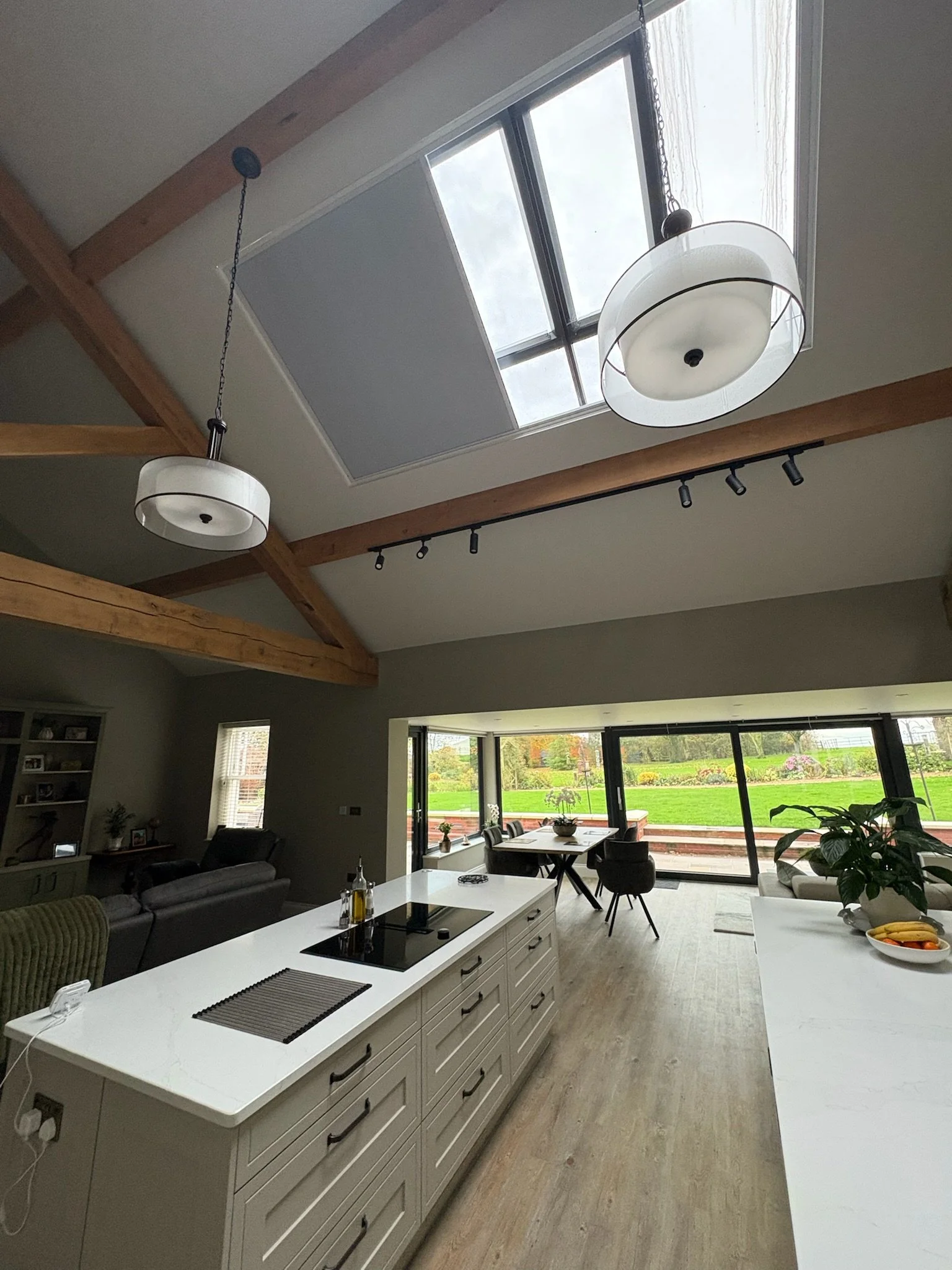
For lanterns up to approximately 2.5m wide and 4.5m long, a single motorised blind on one cassette covers the full opening. The belt-track system keeps the fabric taut with no guide wires visible when the blind is open — a clean, wire-free result that preserves the lantern's appearance entirely.
Up to approx 2.5m × 4.5mFor longer lanterns — typically over 4.5m — two blinds are installed end-to-end, meeting neatly in the middle when closed. Each blind operates independently or together as a group. This is the standard approach for larger kitchen extensions and garden rooms where a single blind would be too heavy or have too long a run for reliable operation.
Large lanterns · Up to approx 9m longFor very wide lanterns, multiple blinds can be fitted side by side — each on its own cassette — to cover the full width. This is common on unusually wide or square lantern configurations where a single wide blind would be impractical. Each blind operates independently, giving flexible control over which sections of the lantern are shaded.
Wide lanterns · Flexible zone control
Orangeries
Panel blinds for
traditional orangeries.
Traditional orangery lanterns — with multiple pitched glass panels arranged around a central ridge — call for a different approach to a modern rectangular lantern. Rather than a single spanning blind, we fit individual pleated or honeycomb blinds to each glass panel, following the pitch of the glazing from ridge to eaves.
This panel-by-panel approach gives exceptional flexibility — particularly useful on south-facing orangeries where the sun tracks across the roof throughout the day. Individual panels can be closed as the sun moves, while the shaded side remains open. The result is practical, considered and visually sympathetic to the traditional architecture.
Each glass panel has its own blind — shade the sunny side while keeping the shaded panels open for maximum light.
Blinds are made to the exact angle and size of each panel, sitting flush to the glass for a clean, integrated look.
Individual panel blinds can be motorised with group control — open or close the whole lantern at once, or manage panels individually.
Both fabric types are available for orangery panel blinds — we advise on the best choice for your specific orangery at the survey.
How We Work
From survey
to perfectly shaded.
One of our small team visits your home to assess your lantern properly — measuring dimensions, checking frame depth, assessing orientation and discussing how you use the room. We'll advise on blind type, fabric and power source with no obligation.
We put together a full written specification covering blind type, fabric, motorisation and power source — with a clear, itemised quote. Fabric samples are left with you so you can consider the options at your own pace.
Your blind is made to the exact dimensions of your lantern — every measurement verified against your specific frame. Manufacturing lead time is typically 3–5 weeks depending on fabric and motor availability.
Our team fits, tensions and commissions your blind — including full smart home pairing if motorised. We won't leave until everything operates perfectly and you're completely happy with how it works.
Why James Albert
Specialists, not
generalists.
Lantern blinds are one of the most technically demanding window treatments to specify and fit correctly. Get the system wrong and the blind sags, operates unreliably, or simply doesn't perform as expected. We've been doing this for over 17 years — and as a small team, every job we take on gets our full attention.
You won't deal with a salesperson and then a separate fitting team. You'll deal with us — the same people — from the first call to the moment we pack up and leave your home.
We've been fitting lantern blinds across hundreds of Lancashire homes since 2007 — extensions, orangeries, skylights and more.
Fully accredited to specify and install motorised systems — one of a select number of specialists in Lancashire.
No call centres. No subcontractors. The person who surveys your lantern will be the one who fits the blind.
We'll tell you what your lantern actually needs — not push you towards a more expensive system if a simpler one will do the job perfectly well.
Questions
Frequently
asked.
In almost every case, yes — though manual operation is possible using a long operating pole to push and pull the blind from below. For most people this is inconvenient on a daily basis, which is why motorisation is by far the most practical choice. Battery, solar or mains power all remove the need to handle the blind manually at all.
Not with the systems we install. We use belt-track tensioning rather than cord or wire guides — meaning the float bar runs straight and true with nothing visible across the opening when the blind is raised. This is one of the key things to check when choosing a lantern blind supplier.
For most lanterns, honeycomb is our first recommendation — the thermal performance is exceptional and the light-diffusing quality is beautiful. Pleated is a good choice where frame depth is limited. Roller suits contemporary, large-span lanterns particularly well. We'll advise specifically at your survey based on your lantern and how you use the room.
For most retrofit projects, battery power is the right choice — no disruption, no rewiring, and modern rechargeable motors last 3–4 months between charges. For new builds or major renovations where the ceiling is open, we recommend running mains power to the lantern head at build stage. Solar is a great upgrade if the lantern is in a well-lit position.
Yes — all our motorised lantern blinds use Somfy motors, which are compatible with Apple HomeKit, Google Home and Amazon Alexa. You can control blinds by voice, via the Somfy app, or set automated schedules based on time or sun position. We handle the full pairing and setup as part of the installation.
Light-filtering honeycomb or pleated fabric is the right choice for most rooms — it reduces glare and heat significantly while keeping the room feeling bright and pleasant. Blackout is best reserved for lanterns above bedrooms or media rooms where total darkness is genuinely needed. We'll bring fabric samples so you can see the difference at your survey.
Large lanterns are covered by a meet-in-the-middle or side-by-side configuration — two or more blinds that together cover the full opening. Each blind operates independently or as a group. We'll specify the right configuration for your dimensions at the survey, with no upper limit on the overall size we can cover.
Yes — and we have plenty of experience with them. Traditional orangeries with multiple pitched panels require individual blinds fitted to each panel rather than a single spanning system. We specify pleated or honeycomb blinds to follow the pitch of each glass section, with motorisation available for the whole lantern as a group or per panel.
Most lantern blind installations are completed in half a day by our fitting team. Larger or more complex installations — multiple panels, mains wiring, or very large configurations — may take a full day. We'll give you a realistic time estimate when we provide your quote.
We're based in Preston and cover the whole of Lancashire — including Chorley, Blackburn, Blackpool, Leyland, Clitheroe, Garstang, Longridge and Southport. For larger or more complex projects we travel further afield across the North West and nationally where required.
Free Survey · Made to Measure · Expertly Fitted
Ready to transform
your lantern?
Book a free home survey and one of our team will assess your lantern, advise on the right system and leave you with fabric samples and a clear, no-obligation quote.